

The MX1: Unpacking How Pleated Leather Made a Signature Jean
Almost all luxury houses hinge on a single style that frames the rest of the line, and for this Los Angeles label that product is the MX1. The jean itself is a skinny five-pocket cut, abraded by hand and then remade with pleated leather seated into the abraded zones. At an observed market price of $1,090 it leads the core denim range, and every other style is measured against it. More affordable jeans exist in the line, so do newer ones and more extreme ones, yet amiri jeans still conjures this one. What follows is how a repair technique became a house signature, what the jean is made of, and which repeated claims do not survive checking. Prices throughout are observed market listings rather than an official price list.
A Maxfield capsule, plus a founding date open to argument
The label was established by Mike Amiri in his hometown of Los Angeles, and its own about page gives the year as 2014. The CFDA repeats it, so does the Italian group that later took a minority stake, and so does the standard encyclopedia entry. A press release dated 3 December 2014 says something else, placing the founding in 2013 and describing it as a partnership with the luxury retailer Maxfield. Since both survive scrutiny, the careful formulation keeps both, with the brand’s own date at 2014 and the earliest contemporaneous release at 2013. The launch vehicle draws no argument, an exclusive capsule collection at that Los Angeles concept store. The jeans in that capsule were already doing what the MX1 does now, which is why the model reads as a first principle rather than a later addition.
What he was doing before all this
Brand copy and the CFDA repeat identical careful phrasing about the founder’s start, that he began by amiri hand-crafting unique stage pieces for legendary Los Angeles performers. That is the extent of what either source asserts, and the specific rock clients named in retailer editorial are secondary reporting rather than brand statement. The safe formulation is that he is widely reported to have made stage pieces for particular performers, not that the brand says so. According to the same 2014 release, he had over ten years in the luxury market and had developed projects for Helmut Lang, J Brand and RRL. That is brand messaging rather than confirmation from those companies, so cite it that way. The same release also announced his appointment as head designer of ready-to-wear and accessories at Buscemi, a documented detail most coverage leaves out.
What the jean is, in detail
Per the official copy it is a skinny-fit jean cut from Italian stretch denim, built with classic five pockets, worn by hand and repaired with pleated leather. The contrast material is stated as ovine leather, rather than a unspecified leather and certainly not a synthetic. Fibre content is 92 percent cotton, 6 percent elastomultiester and 2 percent elastane, and the model is a Core Collection piece. Origin is the USA, which counts both as a point about the brand and as an authentication check. Because style codes are structured, a code that does not match the style and the colourway is a red flag. Knee and thigh are where the abrasion goes, and the pleated panels are set into those zones, so the leather occupies the gap instead of covering sound denim.
What the pleating adds
Price rests on construction here, and the detail deserves precision. Distressing on its own is trivial to imitate, whereas a repair that replaces missing denim with a shaped leather insert is a second operation stacked on the first. A third step arrives with the pleating, because the panel has to be pressed before anyone can set it into an irregular opening. Because the distressing is hand-finished, no two openings are identical, so the panels cannot be cut to a single template. That irregularity doubles as the most reliable at-a-glance authentication tell, since counterfeit distressing comes out repetitive and flat. It is the hardest part of the product to fake at volume, and it is the actual product.
One structural idea, many finishes
The variants work because the repair position, once created, will accept anything. On the MX1 International, pleated bandana print stands in for the leather in exactly the same structural position. The MX1 Bandana Jacquard repeats the move with a woven paisley, and Stud and Aloha versions apply hardware and print to that same base. Colourways run from black through several indigo washes to white. This is exactly why Bandana and Crystal should never be listed as fits, because they are treatments and can land on the MX1, the Thrasher or the Shotgun alike. Below, the table holds the base jean apart from the treatments applied to it.
| Name | What changes | Detail |
|---|---|---|
| MX1 | Repairs in pleated ovine leather | Base jean, observed $1,090, made in the USA |
| MX1 International | Pleated bandana print takes over from the leather | Identical structural position |
| MX1 Bandana Jacquard | Woven paisley supplants the plain leather | The fit is unchanged, the treatment is not |
| Stud MX1 | The base jean plus metal studding | Sits in the upper band |
| Aloha MX1 | Printed motif applied to the base | Seasonal, not permanent |
| Baggy MX3 | A separate hybrid, motocross-inspired | Women’s piece, observed $990, no tier above the MX1 |
Price now, and resale later
The observed full price is $1,090, against $750 for the Stack jean at the other end of the core range. On the main denim resale platform the listings cluster roughly between $480 and $650, and the outer spread runs from about $400 to $840. Suede and unusual-material versions sit at the lower end, because specialised materials depreciate harder. The structural reason is visible discounting through authorised retail, roughly 40 to 70 percent in-season, followed by off-price channels. That sale floor caps what a secondary buyer will pay, and high counterfeit density adds an authentication discount on top. Read none of it as investment advice, since the MX1 is a garment to wear rather than something to hold.
What a pair is like to own
Because complete measurements are not released for every style, sizing guidance is crowd-sourced from buyers rather than published. The cut is deliberately narrow, and while the waist runs broadly true to the labelled inch, the leg is what sends people up a size. Anyone with muscular thighs or calves tends to report going up one or two, which turns a skinny line into a slim one. Care is stricter than ordinary denim, since core pairs are spot-clean only, with no washing, bleaching, tumble drying, ironing or dry cleaning. The care copy also flags intentional shading variation and possible dye transfer, both properties of the finish rather than defects. The checks below are worth running before money changes hands.
- Check that the origin label reads USA, because a jean marked as made in Italy contradicts the core denim
- Confirm the style code is structured and matches both the style and the colour
- Check the contrast material is named as ovine leather rather than left vague
- Hand distressing should read as irregular and asymmetric, never as repeating machine abrasion
MX1 claims that break down on inspection
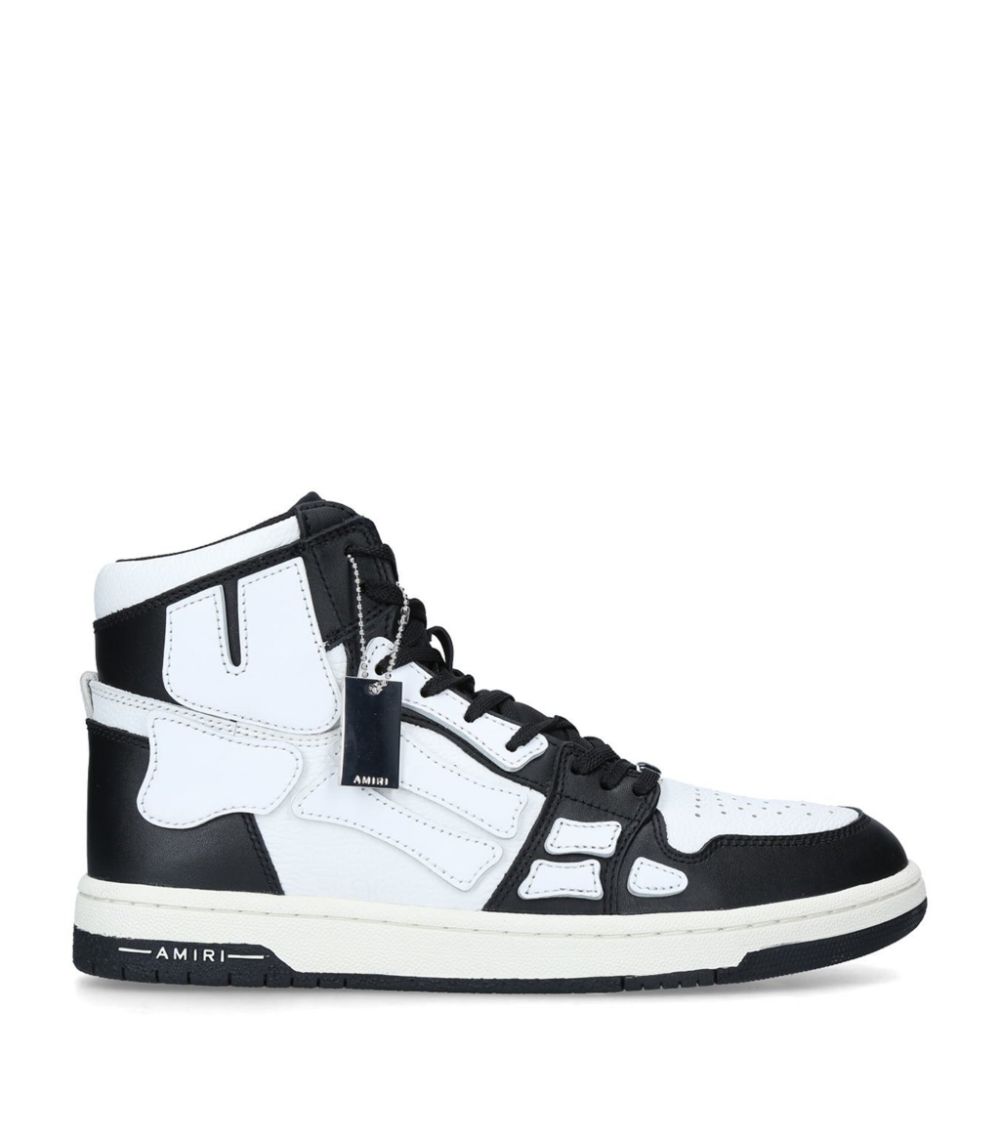
The most persistent is a numbered ladder, where the MX1 is leather, the MX2 is bandana and a third model is heavier destruction. Nothing verifies it, and it looks like search-optimised copy copied from site to site, because the brand’s own site carries only one MX3, a women’s Baggy MX3 at an observed $990. That piece is a no-waistband, motocross-inspired hybrid, not a men’s tier above the MX1. The name MX2 is real, its collection pages returned no live products when checked in 2026, and the split over its defining feature, contrast inserts or zippered knee vents, is not settled. Reading MX as motocross is a reasonable inference from the MX3 description, yet it is an inference and not a brand statement about the MX1 name. The claim that all amiri clothing is made in Los Angeles is false as well, since the MX1, the Stack and the core amiri hoodie are US-made while amiri sneakers are made in Vietnam.
How the MX1 functions now
No style in the current range has taken its place. It remains part of the Core Collection, remains at the top of the standard denim band, and remains the model resale platforms build dedicated browse pages around. Volume has moved from the skinny shapes to the roomier cuts, so anyone looking at amiri men now finds Carpenter, Baggy and MA Fit options that played no part in the early years. The MX1 now reads as a reference rather than a default, and that is a normal life cycle for a signature product. The safest way to buy one is still the brand’s own channel or a retailer named on its published stockist list, since no official outlet exists. By the brand’s own legal position, any site posing as one is not the brand.